Showing posts with label Health and Nutrition. Show all posts

22 May 2025

Ten Weight Loss Program Red Flags


The "weight loss industry" in the United States reached an annual size of over $93Billion in 2024. The market for prescription weight loss drugs alone has more than doubled from $5Billion in 2022 to $12Billion in 2023. And yet 1 in 5 Americans are still obese (not overweight, obese) in all 50 states and 35% or more are obese in 23 states. With this much money being spent every year, why are people not losing weight and keeping it off? Could is be that the majority of the weight loss industry, including the whole class of unnecessary GLP-1 weight loss drugs, is peddling snake oil instead of success?

As has been true for all time, over the long haul there is only one diet that works: consume fewer calories and/or burn off more. Lifestyle changes such as exercising more and eating mindfully are a key component of successfully losing weight and avoiding the yo-yo cycle of losing weight and regaining it back over and over again (as 75% of dieters do).

Does this mean that there are no weight loss programs that can help you successfully lose weight and keep it off? Of course not. But the fact is that you can certainly accomplish it on your own (I did). But if you need guidance, help getting started or someone to be accountable to then a weight loss program may be for you. But you have to be careful to avoid all the fluff and nonsense that makes up the majority of such programs.

The National Council Against Health Fraud has published a list of 10 guidelines that you should consider in evaluating any weight loss program. Any of these should give you reason to avoid the program.

1. It promises dramatic, rapid weight loss of more than 1% of total body weight per week. That is 2 or 3 pounds for a person who weighs 250#. More rapid weight loss is not sustainable long term and may even be unhealthy.

2. It requires extreme calorie restriction (under 800 - 1,000 calories per day). The only time this should ever be done is under qualified medical supervision. 

3. It requires purchasing special foods or products only available from a single source (aka, them).

4. It ignores the importance of exercise and behavioral/lifestyle changes. Without these you will most likely just regain any weight that you lose.

5. It requires you to invest a significant amount of money up front for a membership or subscription and does not offer a refund if you are dissatisfied or do not see results.

6. Claims are made of secret, special or proprietary ingredients not available anywhere else, especially if the "ingredients" are not revealed.

7. Promises that you will "lose belly fat", or fat from any other specific area of your body. You cannot target weight loss that way. 

8. Fails to address long term success and provide a transition to maintaining your weight once you reach your goal. (GLP-1 drugs for example offer no such transition, you just have to keep taking them and will regain the weight you lost if you stop doing so. This has spawned an entire mini-industry to help wean people off the drugs by basically doing the things that would have made the drugs unnecessary in the first place!)

9. Restricts you to consuming a limited number of foods or macroeconomic classes. (A balanced diet is what works.)

10. Claims that it will be easy or that no changes to your diet or lifestyle will be needed (just their product).

As anyone who has successfully lost a significant amount of weight and kept it off will tell you, these are common sense considerations. Use them to assess any weight loss products or programs that you are considering and walk away from any that check any of these boxes.


21 May 2025

Intermittent Fasting - Fad or Fabulous?


Intermittent fasting - taking nothing but water - for 12 to 16 hours a day has become a popular routine for many people who believe that it improves their health.

It turns out that I am an intermittent faster and never even knew it! Typically I have dinner between 6:00pm and 7:00pm every day. I hardly ever have anything more to eat after that. I start my day at about 7:30am and, by the time I am up and about and take my dog out for his walk, its is around 9:00am before I have breakfast (if I do at all). So without even realizing it, I have been "intermittent fasting" for around 14 hours just about every day. 

I also make a 36 hour fast for 2 days every month, but that is a story for another time.

What is the science behind fasting? Does it really have any health benefits or is it just one more unfounded, social-media-driven wellness fad?

It turns out that intermittent fasting can help with weight loss, improve heart health, reduce inflammation, and enhance cellular repair processes. It may also lead to better blood sugar control and increased energy levels.

But according to the Mayo Clinic, the long-term health effects of intermittent fasting aren't clear. And some studies find just limiting calories in general may have the same benefit as intermittent fasting. Also, researchers don't know if different fasting cycles have the same benefits. Some evidence suggests that a 16-hour fasting, 8-hour eating cycle may raise heart disease risk compared with other time-restricted eating cycles.

Eating during a short window often means skipping breakfast or dinner. If those meals are important parts of your social life, then intermittent fasting may not work for you. And while intermittent fasting is safe for most people, it may not be a healthy pattern for people who:

  • Have an eating disorder.
  • Are pregnant or breastfeeding.
  • Are at high risk of bone loss and falls.

Still, for many people, a 12 to 16 hour daily fast may fit easily into their lifestyle with little or no change. If you are considering it, it may not be a difficult adjustment at all. Here is a short article that discusses the pros and cons.


14 May 2025

Healthy Plant Oils for a Longer Life?


Plant oils get no respect on the fringes of the weight loss and dietverse, but a 2025 study published in JAMA Internal Medicine suggests that consuming about 2 tablespoons of healthy plant oils every day can add years to your life. The researchers tracked over 220,000 adults for over 30 years in concluding that those consuming plant oils daily faced a 16% lower risk of dying over the study period than those who did not. Plant oil consumption also seemed to provide a protective effect against some forms of cancer. The study found statistically significant associations between higher intakes of specific plant-based oils and lower mortality risk.

To be sure, not all plant oils are equal. The study examined canola, soybean and olive oils - all rich sources of polyunsaturated and monounsaturated fats. Oils high in saturated fats, such as palm and coconut oils, would not be expected to have the same beneficial effect on mortality.

Substituting a healthy plant oil for butter - which his more than 50% saturated fat - on your bread doubles the benefit! Just remember that all plant oils are 100% fat so they will contain a lot of calories.


09 May 2025

The Declining Nutritional Content of Our Food Supply


You are eating well, buying fresh fruits and vegetables, whole grains and avoiding processed foods as much as is practical for you. So you are doing just fine so far as giving your body all of the nutrients it requires to thrive, right? Not so fast!

Many modern fruits, vegetables, grains and even meats are less nutritious than those grown decades ago, with significant declines in essential nutrients like protein, calcium, and vitamins. There are increasing concerns that in our rush to grow food on ever bigger scales using industrial farming methods and genetic modifications that we have inadvertently caused its nutritional content to wane. Let's unwrap this mystery of the declining nutritional quality of foods, and discover why our salads may not be as virtuous as we think.

First, let's shine a light on modern "industrial" agricultural practices. A 2009 study from HortScience of produce from the United States and the United Kingdom found an inverse relationship between crop yield and how much nutritional value they had. In other words, the higher the amount of a certain crop harvested, the less nutrients it had. One commonly cited explanation for this decline in nutrients is the degrading quality of soil from overfarming, otherwise known as soil depletion. Think of soil as the earth's pantry—it holds the goodies that make our crops healthy. But intense farming practices and the use of chemical fertilizers strip the soil of vital minerals. Without these minerals, fruits and veggies are unable to absorb them. They may end up looking vibrant and delicious but lacking in the nutrient department. 

Then there is the matter of food processing. The fact is that nearly all of our food is processed to some degree. Even fruits and vegetable are harvested, stored and shipped using additives and techniques that keep them looking sharp but which can compromise their nutritional content. Take whole grains, for example. When processed, they often lose valuable fiber, vitamins, and minerals—making it a risky swap from a health perspective. In essence, while processed foods are definitely time-savers, that comes at a cost in food quality.

Finally, let’s not forget our friend and blame-it-for-everthing villain, Climate Change. Before rolling your eyes and moving on bear with me a moment. Climate change isn't just giving polar bears a hard time. It’s also affecting our crops. Rising temperatures, the increasing concentration of carbon dioxide in the atmosphere and increasingly unpredictable weather patterns impact how plants grow, sometimes speeding up their growth cycle. This hasty growth can lead to plants not absorbing the full range of nutrients from the soil.

The problem with the decrease in the nutrient content of our foods should be a matter of great concern as we can no longer accurately predict how much of something we should eat to achieve a well-balanced diet, suited to our body’s needs. As a result, achieving a healthy diet may prove difficult, leaving us at great risk for nutritional deficiencies that may, over time, engender various health problems. So what are we to do?

This problem required decades to develop and will not be resolved rapidly, even if it receives the attention it deserves which, so far, it has not. A sensible, high quality daily supplementation regimen can help to close the developing gap, but this comes with problems of its own. Many supplements use low quality ingredients of questionable efficacy and some do not even contain the nutrient types or quantities listed on the label. So while supplementing may be helpful, be sure that you know what you are really getting. Buying fresh foods from local farms, ranches and farmer's markets may provide you with better quality, more nutritious foods. Using flash frozen fruits and vegetable may eliminate some of the losses cause by traditional processing and shipping. We can't go back to farming our own food with a hoe and horse-drawn plow, but we can be more conscious consumers. Opt for organic when possible, include a variety of foods in your diet to maximize nutrient intake, and investigate where your produce comes from.

Long-tern there are a number of things that can help to reverse this trend. As consumers become more aware of the connection between diet and health, the demand for nutrient-dense foods is on the rise. By favoring whole, minimally processed foods rich in essential vitamins, minerals, and antioxidants, individuals can send a clear message to the food industry about their preference for nutritionally valuable options.

Choosing to support local farmers and embracing regenerative agricultural practices can significantly contribute to improving food nutrition. Local produce often undergoes less processing and has a shorter journey from farm to table, preserving its nutrient content. By investing in local markets and products, consumers encourage sustainable farming methods that prioritize soil health, biodiversity, and nutrient retention.

Beyond individual choices, advocating for policies that incentivize sustainable farming practices and prioritize food quality is essential. Supporting initiatives that promote regenerative agriculture, reduce chemical use, and encourage responsible land management can drive systemic change within the agricultural industry. Such policies foster an environment where nutrient-rich foods become more accessible to all.

The decline in nutritional value poses a significant challenge to public health, underscoring the need for collective action. By understanding the factors contributing to this decline and making conscious choices, consumers, farmers, and policymakers can collaboratively work towards a more nourishing and sustainable food system.

For a more in depth, technical discussion of the problem of declining nutritional content in or food you can dig into this paper from the National Institutes for Health's Center for Biotechnology Information.


07 May 2025

Nutrition and Mental Health


If you are taking the time to read this, you are probably well aware of the strong connection between the nutrition you get and your physical health. A healthy diet helps to protect against malnutrition in all its forms, as well as noncommunicable diseases, including diabetes, heart disease, stroke and cancer. In 2021, 20% of all deaths worldwide were associated with poor diet, about 11 million people. But what about our mental and emotional health?

In fact, nutrition plays a significant role in mental health, as the foods we eat can affect our mood and cognitive function. A healthy diet rich in fruits, vegetables, whole grains, and healthy fats can help reduce symptoms of depression and anxiety, while processed foods and sugars may contribute to mental health challenges. Earlier studies suggest what you might expect: eating junk isn’t great for your brain. People who consume plenty of fruit, vegetables, and fish seem to be less at risk of depression compared to those who favor fatty meats, processed carbs, and sweets. But new research suggests that the connection between diet and mental well-being is a little more nuanced than scientists once thought.

No single food has magical powers (The "superfood myth".) “We want to shift the conversation away from singular foods and diets and into talking about food categories,” says Drew Ramsey, an associate professor of psychiatry at Columbia University. His studies, for example, found that spinach, Swiss chard, kale, and lettuce contain the highest antidepressant nutrients per serving, but that it didn’t really matter which leafy green you ate—what matters is that leafy greens are a regular part of your food intake

Nutrition is just one piece of the mental-health puzzle, but it has researchers excited. “I really am a big fan of responsibly using medications and effective talk therapy to treat depression,” says Ramsey. “But focusing on diet allows us to empower patients to think about their mental health as tied to nutrition.”

Here is a deeper dive if you want to know more. If you just what the short version, here are the top three food categories for a healthy mental diet:

  • Complex carbohydrates: Foods like brown rice and starchy vegetables provide energy. Quinoa, millet, beets, and sweet potatoes have more nutrients and keep you satisfied longer than sugary snacks.

  • Lean proteins: These give you energy and help your body think and react quickly. Good sources include chicken, meat, fish, eggs, soybeans, nuts and seeds.

  • Fatty acids: Essential for brain and nervous system function, you can find them in fish, meat, eggs, nuts and flaxseeds.


02 May 2025

Your Most Important Defence Against High Food Prices


Between 2020 and 2024, food prices rose nearly 24%. This was due to a variety of factors including supply chain disruptions due to the Covid pandemic and the Ukraine war, rising transportation costs, the avian flu and the overall rate of inflation. Depending upon how President Trump's tariff wars turn out, prices may continue rising and shortages may become more common.

While there is little that we as individuals can do about any of these causes of rising food prices, there is one thing that we can do to have an impact and save us money at the grocery store too - reduce our personal food waste. In America we waste about 90 million tons of food annually, or about 35% of our food supply. This waste occurs at every stage of the supply chain, from farm to table. But the average American family wastes a staggering amount of the food that it buys.  The Natural Resources Defense Council (NRDC) estimated that the average American household throws away about $1,600 worth of food each year. This number translates to significant financial losses for families alongside the environmental damage. These figures often include food that spoils, is forgotten in the refrigerator, or is simply discarded due to misjudging portion sizes.

Here is where you can have a big impact, both on your wallet and the food supply. 

One of the primary causes of household food waste is overbuying. Many consumers regularly purchase items they do not need. Without effective meal planning and accurate grocery lists, households often end up with food that spoils before it can be consumed. With the new generation of free, easy to use meal planning apps there is no longer any reason to waste your money on food you will not eat. (Here is the one I use: mealime.com )

The confusion surrounding expiration and “best by” dates contributes greatly to food waste. Many consumers mistakenly believe that food past its “best by” date is unsafe to eat, leading them to throw away perfectly good items. However, these dates often indicate quality, not safety. Use your nose, not the "best by" date.

Improper food storage can also significantly contribute to waste. Not storing food at the right temperature or using the wrong storage containers can lead to premature spoilage. For example, storing fruits that release ethylene gas near ethylene-sensitive vegetables can cause the latter to ripen too quickly and spoil. Similarly, failing to seal containers properly can cause food to dry out or become contaminated, rendering it inedible. A temperature of about 36deg is right for your refrigerator and close to 0deg for your freezer (Fahrenheit). Use a thermometer.

But perhaps your best defense against food waste, and probably your least effectively used one, is something you already have in your kitchen - your freezer. You probably vastly underestimate the variety of foods that can be safely stored in your freezer, this preventing premature spoilage and waste.  Learning what foods to store in your freezer and how to store them properly can go a long way to helping you save both money and time. Otherwise, your freezer just becomes an intermediary between the stove and the trash can.

Many foods that you have probably never considered freezing will store perfectly well in the freezer. Apples, bananas, tomatoes, eggs (yes eggs!), milk and many vegetables and fruits all freeze well. But they do not all freeze well the same way!

Here then is a handy guide to freezing that will quickly having you throwing away less food, saving money at the grocery store and even saving you time preparing meals.

If you have developed any tricks of your own, please share them in the comments so that we can all benefit. With food as expensive as it now is, it is just crazy to be throwing away a third of what we buy.


18 February 2025

Eggspensive!


Eggs have long been a cheap source of protein and come with a host of important vitamins and minerals including vitamin D, phosphorus, vitamin A, and two B-complex vitamins that your body needs to convert food into energy. Eggs are also a very good source of riboflavin, selenium, and choline. They still are nutritional heros but thanks to the millions of chickens that have died or been destroyed due to the bird flu outbreak, they are no longer cheap. The image above is from a grocery store in southern California, which has been particularly hard hit. There are even stories of egg entrepreneurs snatching up every egg they can find and reselling them to desperate consumers and even business at, shall we say, scalper prices.
 
But in addition to making regular appearances at breakfast table, eggs are also in an enormous variety of other foods, who's prices are now also rising as a result of the egg shortage. Baking, in particular, depends on them.
 
So for something entirely different, here are 25 egg-free desert recipes. I have tried a few of them and you will not miss the eggs. The strawberry shortcake that tops the list was a big hit at a recent church social that I brought them to. Try a few and brighten up your egg-free day.
 
And if you have any tips as to how to better manage in a world of $0.60 eggs, please do share in a comment.

31 January 2025

How Is France Avoiding the Global Obesity Trend?


Worldwide adult obesity has more than doubled since 1990, and adolescent obesity has quadrupled. In 2022, 890 million were living with obesity. That is 1 of every 8 people on the planet. Previous estimates by the World Obesity Federation suggested that there would be 1 billion people living with obesity by 2030, but we surpassed that number in 2024. More than half of the global population—51%, or over 4 billion people—will be obese (not overweight, obese) by 2035, and the condition will touch all regions and continents of the world. The new projection marks a sharp jump from current numbers.

The total cost of treating illnesses related to obesity will be an estimated $4 trillion per year, which is about how much the COVID-19 pandemic cost the world in health care expenses in 2020. Meanwhile, the total U.S. weight loss product market grew to a historic $90 billion annually (2023 data), boosted by soaring sales of popular (and very expensive) prescription weight loss drugs. And yet we are fatter than ever. So fat, in fact, that instead of dealing with it, the US seems to be shifting its focus to accepting and living with it.

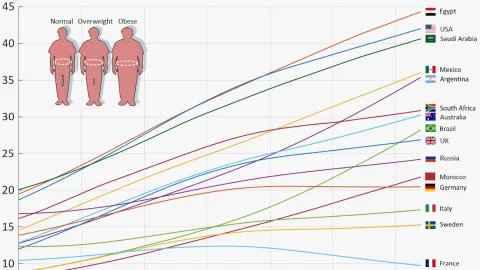
A quick glance at the graphic above shows that this truly is a global problem, impacting countries large and small. Thanks to Egypt, the USA is not the fattest country on the planet but we can take scant comfort in being #2.

A close look, however, reveals an interesting discrepancy. Of the 15 countries shown in the chart, only two do not show an ever increasing rate of obesity among their citizens. In Germany the obesity rate has leveled off, while in France is is actually decreasing.

How have these two countries managed to rein in the soaring rate of obesity? It turns out to be no mystery: by eating less and being more active on a daily basis. They didn't need $900 a month drugs or supplements or special diets or coaches or gym memberships to do it.

The French government introduced its National Nutrition Health Program in 2001, targeting schools, the food industry, restaurants and researchers, setting national standards, providing financial and educational support and tools and programs. It seems to be working.

In Germany, the flattening of the obesity rate seems due to changing eating habits, with younger generations consciously choosing a lighter, healthier diet over traditional German fare.

So with government intervention or without it, it seems to have come down to what we all knew all along. We eat too much of the wrong things and spend too much time sitting.

What are you going to do?

21 January 2025

Eating Healthy on a Budget


Nobody who has been in a grocery store in the last few years needs to be told that food prices have increased dramatically. Prices have risen almost 26% over the last 4 years. To put that in perspective, a basket of groceries that cost you $100 in November 2020 would now set you back $125.80. That’s an increase of nearly $26 for the exact same food items.

But you are not getting the exact same food items. Many producers have quietly been shrinking the amount of product included in their packages, sometimes very significantly, while keeping prices the same. A sneaky way to charge you more without appearing to. Luckily the impact of this is small, but enough to boost the real price you are paying for food by about 4% above the actual price increases.

And all of this is just since November 2020.

Unfortunately, as food prices rise, the price of fresh, healthy foods seems to rise even faster than the price of processed foods does. Thanks to government subsidies of many processed foods, eating healthy on a budget can seem difficult when other choices can be more expensive. This can be especially challenging for older people trying to get by on a fixed income.

Here are five easy to implement tips for getting the most from your grocery dollar. In addition, cut yourself some slack. We don't have to be perfect, or buy only more expensive organic produce or avoid using any processed foods. Just do the best you can. Even little things add up.

Always Meal Plan

This may be the single best way to rein in your spending on groceries. It can save you not only money but time. Don't head to the grocery store until you have in hand a list of what you are going to buy. If it is not on your list, don't buy it. Build your list based upon what you plan to eat for the next week. And be sure to check your pantry and freezer to make sure you really need to buy something before you do.

This can be much less work than it sounds. There are many very good meal planning apps and web sites, most with free versions, that can streamline the process, suggest meals that meet your dietary preferences and even generate your shopping list for you. I particularly like Mealime.com, but there are many to choose from.

Buy in Bulk

It only makes sense to buy things in bulk if you are really going to use them and if they will last until you do. But when it makes sense, it can make a lot of sense. Yes it may cost you more on the day you buy, but buying in quantity will absolutely save you money in the long run.

Here is a list of items that you will save money buying in bulk - and a few where it is usually just not worth the effort. Obviously adjust the list based upon your own needs and preferences. There is no reason to stock up on food that your family will not eat! Regularly stocking up on groceries in bulk should easily pay for an annual membership in your preferred warehouse club and still leave money in your pocket.

Make Your Own Cleaning Products

This may sound a little over the edge, but seriously it is not. It will save you money and you will be spreading fewer chemicals all over your home. Many items you probably already have at home, such as white vinegar and baking soda, are the basis for inexpensive and effective household cleaners. I have have a spray on carpet cleaner that is citrus based and works great.

Here are a few basic ideas to get you started.

Find Inexpensive Vegetables

Fresh produce can often be the most expensive items in your shopping cart. But it is also among the best roods that you can eat to support your health and wellness. Here are two great strategies for keeping the price of produce lower. First, educate yourself about what fruits and vegetables are in season and plan your meals around them. Greens and root vegetables and cabbages are available all winter long and are relatively good buys. Summer means summer squash, salads, peppers, and tomatoes.

The second way to keep your cost down is in your freezer. Frozen vegetables are just a nutritionally powerful as fresh ones are. And in fact they can sometimes be the fresher of the two when the season requires shipping product from far away. They also often come cut up so they can even be more convenient than fresh. I can't remember the last time I small diced a carrot.

Make Your Meat Go Further

As a rule, just use a little less and use what you save to create another meal. Save some to use in stews and soups, which can easily do with just a little. Create meals using beans along with a little meat. Like meat, they are a great source of protein. And really, who doesn't like a pot of home made chili?

Here are a few ways of making meat last longer that you may not have considered before.

Honestly, while we can all hope to see grocery store prices stop increasing for a while, you may as well face the fact that they will not be headed lower any time soon. So here are some more savings tips you can use on your next visit.

And if you have a few tips of your own, please share them here so that others can benefit from them too!


15 January 2025

Caffeine and Aging


Caffeine is a staple in many people’s daily routines. However, as we age, our bodies undergo changes that can affect how we process and respond to caffeine. Whether it’s coffee, tea or other caffeinated beverages, billions (yes, billions) of people throughout the world love caffeine for the lift it gives. Recent data estimate that 85% of adults in the United States consume caffeine in some form each and every day. However, there has been a long-standing debate about the potential negative effects of caffeine, especially for older adults.

There are many common misconceptions surrounding the consumption of caffeine by older adults. One prevalent belief is that caffeine is inherently harmful and should be completely avoided as one ages. But while excessive consumption of caffeine can lead to adverse effects, moderate intake can actually have some benefits for older adults.

So what is the real story?

Contrary to popular belief, caffeine can offer several benefits for older adults. One of the main advantages is its potential to enhance cognitive function. Studies have shown that caffeine can improve alertness, attention, and memory, which can be particularly beneficial for older adults who may experience age-related cognitive decline. 

Additionally, caffeine has been linked to a reduced risk of certain health conditions, including Parkinson’s disease, Alzheimer’s disease, and liver disease. Caffeine has been found to boost mood and alleviate symptoms of depression in some individuals. This can be especially important for older adults who may be more susceptible to mood disorders. By incorporating moderate amounts of caffeine into their daily routine, older adults may experience improved mental well-being.

But it is essential to recognize that older adults may also be more sensitive to its effects. As we age, our bodies metabolize caffeine at a slower and slower rate, meaning it stays in our system for longer and longer periods. This can lead to increased sensitivity to caffeine’s stimulating effects, such as jitteriness, anxiety, and insomnia.

It is important for older adults to understand the recommended daily intake. The general guideline is to limit caffeine intake to no more than 400 mg per day and that over 600mg is too much. Four hundred milligrams is equivalent to about four cups of home brewed coffee, although that 20 oz cup you get from Starbucks will contain your entire quota. 

Individual tolerance may vary though, and some older adults may need to consume less caffeine to avoid any adverse effects. It is also important to note that caffeine can have a cumulative effect, especially if consumed throughout the day. Older adults should consider spreading out their caffeine intake and avoiding consuming it too close to bedtime to prevent sleep disturbances. How close is too close? Most experts recommend avoiding caffeine for 6 hours before going to bed.

When it comes to incorporating caffeine into a healthy aging lifestyle, moderation and mindful consumption are key. Here are a few tips for older adults:

  1. Be aware of your own caffeine sensitivity and adjust your intake accordingly. Pay attention to how caffeine affects your energy levels, sleep patterns, and overall well-being.
  2. Stay hydrated by drinking plenty of water alongside your caffeine consumption. This can help mitigate any potential diuretic effects.
  3. Avoid consuming caffeine too close to bedtime to prevent difficulty in falling and staying asleep.
  4. Consult with your healthcare provider to ensure caffeine does not interact with any medications you are taking. This is especially important for older adults who may be on multiple medications. 

For older adults who enjoy caffeine but want to manage their intake one approach is to switch to decaffeinated versions of beverages. Decaffeinated coffee and tea still offer the familiar taste and the comforting ritual of your morning coffee without the stimulating effects of caffeine. I know that probably sounds heretical to many people but it has worked really well for me.

But in general, there is no reason for us to consume less and less caffeine as we age.

09 January 2025

Centenarian Shares Her Healthy Aging "Secrets"


JoCleta Wilson gets out of bed at 4:30am two mornings every week and drives to her job as a cashier at a Home Depot store in Louisville, Kentucky. There is nothing especially remarkable about that except that she was 100 years old in October of last year.

Her life has not been free of health challenges. She’s a breast cancer survivor, has emphysema and chronic obstructive pulmonary disease, and has a pacemaker. But at 100 years old she says that she feels "like 39 having to go into 40 years old."

Shockingly, her successful aging secrets include such unexpected things as staying active and moving (she used to be a dancer and still dances), eating a healthy diet (she prepares most of her meals herself), having a purpose and being socially engaged. Who would have thought it?

She shares her take on staying healthy while getting older here.


08 May 2024

Is It Time to Treat Sugar Like Cigarettes?


In 1964, Surgeon General Luther Terry issued a report on smoking and health saying that tobacco causes lung cancer and is a main contributor to bronchitis, emphysema and other lung ailments. Members of the Federal Trade Commission read the report the day it was released and quickly proposed a mandatory cigarette label that warned, "CAUTION: cigarette smoking is dangerous to your health and may cause death from cancer and other diseases." The legislation ultimately passed by Congress required a warning label with less dire language: "CAUTION: CIGARETTE SMOKING MAY BE HAZARDOUS TO YOUR HEALTH." In 1965, Congress passed the Federal Cigarette Labeling and Advertising Act (FCLAA), which required a health warning on all cigarette packs. In 1970, President Nixon signed the Public Health Cigarette Smoking Act, which banned cigarettes ads on the radio or television. It also required an updated warning on the cigarette packages which read: "Warning: The Surgeon General has determined that cigarette smoking is dangerous to your health." 

In the six decades since the release of the Surgeon General's report on health and smoking the percentage of Americans who smoke has continuously fallen from a rate of 42% in 1965 to an all-time low of 11% in 2021. The results of a February 2023 Centers for Disease Control and Prevention survey found that 57% of U.S. adults now support policies that ban the sale of all tobacco products.

People still smoke of course, and smoking still kills far too many people. Cigarette smoking remains the leading cause of preventable death in the U.S., with tobacco killing more than 480,000 Americans annually and costing more than $240 billion a year in related health care expenses. But the relentless campaign against cigarette smoking ranks as one of the most successful public health campaigns in history.

In comparison, sugar added to sweetened beverages alone kills about 184,000 people every year now. Forty nine percent of the US population is now either diabetic or pre-diabetic and the numbers keep rising. From 2000 through 2020, the US obesity rate increased from 30.5% to 41.9%. During the same time, the prevalence of severe obesity increased from 4.7% to 9.2%. That's right. Nearly 1 American in 10 is severely obese. Obesity-related conditions include heart disease, stroke, type 2 diabetes and certain types of cancer. These are among the leading causes of preventable, premature death. The estimated annual medical cost of in the United States was nearly $173 billion in 2019 dollars.

The average intake of added sugar in Americans' daily diet is about 19 teaspoons for men and 15 teaspoons for women, vs a recommended intake of 12 teaspoons or less.

There is some data to suggest that since added sugar content was required on nutrition lables in 2016 (after a years long fight with sugar producers) Americans have begun cutting back. Maybe it is time to also require a clear, visible warning lable on food just as we successfully did on cigarettes. We will never get everyone to stop smoking or stop drinking sugary beverages. But if we can reduce consumption as successfully as we have with smoking the benefits in the cost of healthcare, lives saved and the quality of those lives might just be enormous.


23 April 2024

Do You Know Your Numbers?


We live in a world of numbers. Phone numbers, addresses, account numbers, dates, bank balances, distances, times. Most of us are pretty familiar with the numbers we need to navigate through the tasks and routines of our day-to-day lives. But what about the numbers that tell the story of our wellness and health?

Our health is a world of numbers too but all to many of us don't know the ones that tell our story. 

When I work with someone who is eager to lose some weight, I usually begin by asking about numbers. What do you weigh now? How much weight do you really want to lose? Almost everyone knows these numbers.

But when I ask about the calories that they consume on an average day or how many they burn off between their daily routines and exercise, most don't have any idea. You can't create a calorie deficit that will produce weight loss if you have no idea how many calories you consume and burn. 

Many people, especially older people like me, are concerned about eating too many carbohydrates or not getting enough protein. But when I ask how much they are consuming day-to-day the most common response is a blank stare.

Hypertension is called "the silent killer" because it typically presents no symptoms until your blood pressure has reached a problematic level and already harmed your health. Yet even the people who know what a good blood pressure target is (hint: 120/80 or lower) rarely know what their own blood pressure is. Some may remember it from their last doctor visit (not the best reading, it tends to be high) but have no idea what it was yesterday.

If you want to improve your health in some way, it makes sense to know where you are starting from. There are apps and tools and inexpensive equipment available to everyone these days that can provide you with the numbers you need to know with very little effort on your part. Do you know your numbers?

Here is some advice from the American Heart Association on the ones that you should know. If weight loss or nutrition are your focus, here are some great tools you can rely on.

Ignorance is not bliss. It's ignorance. 


27 March 2024

We Should Have Higher Taxes!


Don't get me wrong here. I don't like paying taxes any more than anyone else does. Especially when I see how the government spends my money for me. But I am starting to warm to the idea of targeted consumption taxes intended to place the burden of societal costs on those who create those burdens.

Let's consider cigarette smoking as one example. In the United States, cigarettes are taxed at both the federal and state levels, in addition to any state and local sales taxes and local cigarette-specific taxes. There is no doubt that this is burdensome upon and unpopular among smokers. In New York State for example, a pack of cigarettes costs about $10 and roughly half of that cost is taxes. 

But here is the thing. Smoking imposes a very high cost on society, and I am expected to pay that cost through my own taxes, even though I don't smoke. Cigarette smoking cost the United States more than $600 billion in 2018 alone, including:

  • More than $240 billion in healthcare spending
  • Nearly $185 billion in lost productivity from smoking-related illnesses and health conditions
  • Nearly $180 billion in lost productivity from smoking-related premature death
  • $7 billion in lost productivity from premature death from secondhand smoke exposure.

As high as cigarette taxes may seem to smokers, in fact they raise less than $12 billion a year, leaving the other $588 billion for you and I to pay.

A consumption tax like that on cigarettes shifts at least some of the tax burden from society to those who create the costs through their consumption. No one is forced to pay this tax; no one is forced to smoke. Nor are they forbidden from doing so. They are just asked to contribute more to the costs their choice imposes on me.

This brings me around to my point (at last!). While tobacco use indeed imposes a steep cost on society, it pales in comparison to the costs imposed by over-consumption of sugar. A 2013 report estimated those costs as "in excess" of $1 trillion annually. Now, unlike cigarettes, I do consume sugar so taxing it would affect me directly. But I DO have control over how much of it I choose to consume. And in any case, if I think smokers should be financially responsible for the damage caused by their consumption of tobacco then I should also be help to account for the cost of my sugar habit.

Over 100 countries impose taxes on sugar already and have seen reductions in consumption as high as 30%. Such a reduction in the US would have huge and favorable impacts on rates of diabetes, obesity, heart disease and some cancers with concurrent reductions in healthcare spending. No one would be forced to stop consuming sugar and sugary products, only to pay more for the costs they are imposing on others.

When it comes to sugar, we should have higher taxes.

26 March 2024

The Ozempic Craze


Ozempic is a brand of the generic drug semaglutide that is currently FDA-approved to treat patients with Type-2 Diabetes by controlling their blood sugar levels. It also curbs appetite, making it an effective weight-loss drug for people with obesity-related illnesses. Unfortunately, this has made it very much in demand for people looking to lose a little weight for cosmetic reasons. 

So what is the problem with that? 

As various celebrities endorse its off-label use for weight loss, demand has soared to the point of creating artificial shortages of the drug for the people who actually need it. The ethical issue of consuming a drug you do not need at the expense of those who do aside, there are other problematic issues with using Ozempic this way.

Like any hot new “miracle drug,” it’s worth considering the risks—whether that’s “Ozempic face,” the term for someone becoming especially gaunt, or the fact that one recent study of semaglutide found that one third of the weight loss came from muscle, bone mass and lean tissue and not fat. As is often the case for drugs that cause weight loss, the effects regulating diet and portion control generally last only as long as people actively take it. In other words, as soon as you stop taking it, you start regaining the weight you lost. At $935 a dose, that is no small consideration.

Anytime you see the word "craze" popping up regularly, its time to take a closer look. You can do that here.

If you want to lose weight, just do it the safe, healthy and sustainable way - the same way you gained it - slow and steady. If I can lose weight and keep it off anyone can. Its not complicated. Its just not always quick and easy. And for some people that seems to be a deal breaker. 


22 February 2024

More Food Marketing BS


Many people think that what is printed on food packaging is regulated by the FDA and that it therefore cannot be inaccurate or misleading. Unfortunately this is not really true. The actual nutrition label on the package is regulated but little else. Companies are forbidden from printing outright lies but this leaves lots of room for the marketing department to get creative. They realize that healthy sells, so they invest a lot of creative thought into giving their products a so called "health halo", especially when they are not that healthful at all.

"When food marketing is done well, it slips right through the radar of your critical thinking," says Marion Nestle, PhD, professor of food studies and nutrition at NYU and no relation to the food giant of the same name. "It is intentionally designed to make you think emotionally, and before you know it you have picked up a box of junk masquerading as healthy food."

Here are just a few of the ways that you are intentionally being manipulated.

NO CHOLESTEROL!

Cholesterol is only found in animal products. So seeing a no cholesterol claim on any plant based product - say a jar of peanut butter or a bottle of vegetable oil - is not untrue. It is just meaningless. It has no less cholesterol than similar products without the label claim. None at all.

MADE WITH REAL FRUIT/VEGETABLES!

We all know that fruits and vegetable are good for us and that we should probably be eating more of them. So does the marketing department. Remember that the ingredient list on food packages is in order of weight. The farther down on the list an item is, the less of it there is. So if the "real" fruit or vegetable is in the top four or five items on the list it is probably significant. Otherwise it is noise. The same as saying that your salad is "made with real pepper" because you ground a few flakes on top of it. But it is worse than just getting very little "real fruit/vegetables". What you do get is more likely grape or apple juice or processed fruit/vegetable powder. Again not a lie. But not what you are lead to expect.

KETO!

Ketogenic foods contain little or no carbohydrates, especially added sugar. But this by no means is a synonym for healthy. Foods with the keto claim are often ultra-processed and contain additives and artificial sweeteners that are of questionable safety. Probably not what you were looking for.

GLUTEN FREE!

Many gluten free versions of breads, pastas and baked goods are very low in fiber and firmly in the ultra-processed category, making them an unhealthy choice. Even better, you will frequently find this claim on foods that contain no gluten anyway. I have even seen wine advertised as gluten free, as if grapes had any gluten in them to begin with. Unless you have celiac disease or a diagnosed gluten sensitivity there is no reason to avoid gluten in the first place. The number of celebrities swearing by it does not make it a health food.

UNCURED!

Deli meats and hot dogs are normally preserved using synthetic nitrates and nitrites, which are known to raise the risk of some cancers. What to do to coax you into eating them anyway? Preserve your sausage with celery seed powder! It is an "all natural" source of nitrates and nitrites and your body can't tell the difference. "Uncured" may sound healthier, but it isn't. But who cares as long as you buy it.


These examples barely scratch the surface of the many ways that you are mislead, misinformed or manipulated into buying something you think is good for you that is really only good for the manufacturer. After all, they aren't the ones it will make sick. What can you do? Be skeptical and don't rely on anything you see on a food package except the ingredient list and the nutrition label.


21 February 2024

Does Anybody Really Need Suplements?


More than half of all American adults take a supplement product every day, a figure that rises to over 70% among those aged 65 or older. In fact, the use of supplements is so widespread, it has become a $37 billion business. What benefits are people expecting from this? Is it sensible or just a huge marketing triumph and waste of money?

You will often hear that supplementing is a waste of money because we can get all the nutrition that we ever need from our food. This is true. In an ideal world, we'd all be eating copious amounts a variety of nutrient-dense foods such as fruits and vegetables and getting all the essential vitamins and nutrients our bodies need for optimal health. But, here on planet Earth, we're far from that healthful eating ideal.

According to the Centers for Disease Control and Prevention, Americans, on average, eat only about one fruit and one or two vegetables on a typical day. This helps explain why millions of people fall short of the recommended intakes of some vitamins and minerals. For instance, more than 1 in 3 children and teens (ages 9 to 18) don't meet recommended intakes for calcium and vitamin D, according to a study in The Journal of Pediatrics.

Fortification efforts, such as the Food and Drug Administration's requirement that folic acid be added to many cereals and breads, have paid off. Folate levels in women increased by 50 percent between 1993 and 2006. This is critical, since folate helps prevent birth defects. But wait! Isn't adding folate to bread, well, supplementation?

This is the best justification for regularly taking a nutritional supplement - taking a daily multivitamin with minerals may be helpful in closing the gap between what we need and what we actually eat.

A study published in the American Journal of Clinical Nutrition found that supplements helped adults meet the recommended intake of certain minerals, such as calcium and magnesium in men and women, as well as iron for women. Another study by the National Institutes of Health found that in children and teenagers (ages 9 to 18), taking supplements added nutrients (for example, magnesium, phosphorus, and vitamins A, C, and E) for which intakes would have been inadequate from food alone. 

Even those of us who eat a well balanced diet of clean foods may still be missing some key nutrients. Unless you happen to be eating soy, kale, collards, okra and pomegranats you may be coming up short on Vitamin K. Not eating a lot of Brazilnuts, spinach or oatmeal? You may be shortchanging yourself on selenium.

If you have the time and tools to accurately track your micronutrient intake and the ambition to carefully plan and prepare your meals, then the odds are good a supplement would not do you much good. For the rest of us, they are a sensible, affordable insurance policy against dietary deficiency.


20 February 2024

Phytonutrients Give Produce its Coloful Cachet


When it comes to fruits and vegetables we are often told to eat a wide variety of different colored produce - in addition to just eating more. Ever wonder why that is? 

Plants provide an enormous variety of nutrients. Phytonutrients - literally, any substance of plant origin that provides nutrition - number over 5,000. Phytonutrients contain different pigments which give them their color. Focusing on eating a variety of colors will increase your intake of different nutrients to benefit various areas of your health.

Its also a simple way to ensure you are getting a variety of vitamins, minerals, antioxidants and proteins without having to delve into the nutritional contant of each thing you eat (not that you would).

Want to know what red's got that green doesn't? Here is a quick read that will explain what each color contributes to your diet - and your health.


16 February 2024

Healthy Soda?


Carbonated prebiotic sodas with names like Olipop, Poppi and Vive Organic that promise to boost your fiber intake – and your health – by feeding the trillions of microorganisms that live in your gut. Even Coke and Pepsi are muscling their way into the fiber game.

"There's been so much research that has shown that if you consume more fiber, you are healthier," says Hannah Holscher, an associate professor of nutrition at the University of Illinois. She says fiber does way more than just help keep us regular. It helps control blood sugar levels and lower cholesterol and inflammation. A review of 185 studies and dozens of clinical trials found that diets rich in fiber were linked to a lower risk of major health problems like obesity, Type 2 diabetes, cancer and cardiovascular disease. 

Say no more! Big Soda's marketing experts are on the case! Now your fizzy, sugary indulgence comes with inulin, a pre-biotic fiber. Healthy soda is here at last!

Not so fast.

Justin Sonnenburg, a professor of microbiology and immunology at Stanford University says when it comes to added fiber in foods, "the intuition in the field is that that's probably better than nothing."

But it's not at all clear that prebiotic fibers added to processed food and drinks have the same health benefits that come from eating a variety of whole foods that are naturally high in fiber. For one thing, says Sonnenburg, the purified fibers that are added to foods are much simpler structures than fiber naturally found in plant foods. And this means they get fermented faster, by microbes that live near where the small intestine meets the large intestine. That means those purified fibers might not reach the microbes living further down the large intestine – and they need to be fed, too.

Translation? Less unhealthy does not equate to healthy.


07 February 2024

Five Easy Ways to Eat Your Veggies


Ok so you are SO tired of hearing that. Seems like the solution to everything is stuffing more vegetable into your reluctant maw. If, like me, you were traumatized by your mom's firm belief that vegetables were best prepared by boiling them for 12 hours, eating more of them can be an even less appealing prospect. And about 90% of Americans don't eat enough of them.

This is really a shame. Vegetables are a great source of healthy nutrients like fiber, potassium, folate and vitamin A. They also play a big role in helping people lose or maintain weight since all that fiber helps fill you up. Plus, when you're eating more low calorie vegetables there's less space for eating higher-calorie, less-healthful foods. 

If you are tired of heading to the grocery store armed with a list and good intentions only to throw away most of the vegetables that you dragged home, here are five really easy ways to work more of them into your diet.

1. Experiment with how you prepare them.

Growing up, there was one way to prepare vegetables in my home - boil them until you could eat them with a straw. As soon as I was living on my own, vegetables were banished. You too may think you don't like vegetables, but maybe you just haven't tried the right preparation. You can boil them if you want but it is probably the worst way to prepare them, since you leave a good deal of their nutrients behind in the water. Try steaming them. Its fast, they don't overcook and the nutrients are preserved. Tossing them in a little garlic and olive oil and roasting them works especially well for root vegetables and has an amazing power to make even Brussels sprouts taste, well, good. Saute them in a pan. You can even eat them raw!

2. Expand beyond dinner.

Add spinach or peppers or tomatoes to your omelette. Onions are a vegetable and what isn't better with onions? Stuff your sandwich with lettuce, tomatoes, onions and peppers. Toss some cucumber or carrot into your smoothies. You don't have to do anything weird or disgusting (sorry, just not a green smoothie guy). But vegetables are not just for dinner.

3. Find your crock pot and use it.

The crock pot is truly one of cooking's great inventions. Toss a bunch of stuff into it, go on off to work and when you get home, dinner is ready. Soups and stews are both easy to make and a natural place to dump those vegetables that you brought back from the store last week. Soup is a great way to eat more vegetables because you can add a whole lot of produce to your soup pot. Toss some carrots into your chili (I know I said nothing gross but this is not, I promise). 

4. Snack on vegetables.

Keep some veggies cut up into snack-sized pieces in your fridge. You are saving so many calories snacking on them that you can afford to go a little decadent on your dip. Ranch dressing, cottage cheese, cream cheese, salsa and hummus all work to jazz up the carrots, celery and cherry tomatoes. And speaking of hummus, make your own. Just puree a can of chickpeas in your blender with some bell peppers and whatever spices you like. Or roast something weird like kale with olive oil, salt and spices to make healthy snack chips. No one will know.

5. Sneak them into sauces.

Adding extra vegetables to your sauces and dressings is a sneaky way to increase your veggie intake, especially if you have picky kids. While you’re cooking sauces, such as marinara sauce, creole dishes or pesto simply add some veggies and herbs and spices of your choice to the mix. Onions, carrots, bell peppers, and leafy greens like spinach all work well. Just cut them up small. Pureeing roasted root vegetables can make for rich sauces with an Alfredo-like feel.

So there are a few ideas to get you started. If you don't like any of these, here is a list of 22 ways to work more of these nutritional ninjas into your diet routine. You may enjoy the challenge of doing something good for yourself. Heckfire, you may even discover that you like it!