07 May 2025

Nutrition and Mental Health


If you are taking the time to read this, you are probably well aware of the strong connection between the nutrition you get and your physical health. A healthy diet helps to protect against malnutrition in all its forms, as well as noncommunicable diseases, including diabetes, heart disease, stroke and cancer. In 2021, 20% of all deaths worldwide were associated with poor diet, about 11 million people. But what about our mental and emotional health?

In fact, nutrition plays a significant role in mental health, as the foods we eat can affect our mood and cognitive function. A healthy diet rich in fruits, vegetables, whole grains, and healthy fats can help reduce symptoms of depression and anxiety, while processed foods and sugars may contribute to mental health challenges. Earlier studies suggest what you might expect: eating junk isn’t great for your brain. People who consume plenty of fruit, vegetables, and fish seem to be less at risk of depression compared to those who favor fatty meats, processed carbs, and sweets. But new research suggests that the connection between diet and mental well-being is a little more nuanced than scientists once thought.

No single food has magical powers (The "superfood myth".) “We want to shift the conversation away from singular foods and diets and into talking about food categories,” says Drew Ramsey, an associate professor of psychiatry at Columbia University. His studies, for example, found that spinach, Swiss chard, kale, and lettuce contain the highest antidepressant nutrients per serving, but that it didn’t really matter which leafy green you ate—what matters is that leafy greens are a regular part of your food intake

Nutrition is just one piece of the mental-health puzzle, but it has researchers excited. “I really am a big fan of responsibly using medications and effective talk therapy to treat depression,” says Ramsey. “But focusing on diet allows us to empower patients to think about their mental health as tied to nutrition.”

Here is a deeper dive if you want to know more. If you just what the short version, here are the top three food categories for a healthy mental diet:

  • Complex carbohydrates: Foods like brown rice and starchy vegetables provide energy. Quinoa, millet, beets, and sweet potatoes have more nutrients and keep you satisfied longer than sugary snacks.

  • Lean proteins: These give you energy and help your body think and react quickly. Good sources include chicken, meat, fish, eggs, soybeans, nuts and seeds.

  • Fatty acids: Essential for brain and nervous system function, you can find them in fish, meat, eggs, nuts and flaxseeds.


02 May 2025

Your Most Important Defence Against High Food Prices


Between 2020 and 2024, food prices rose nearly 24%. This was due to a variety of factors including supply chain disruptions due to the Covid pandemic and the Ukraine war, rising transportation costs, the avian flu and the overall rate of inflation. Depending upon how President Trump's tariff wars turn out, prices may continue rising and shortages may become more common.

While there is little that we as individuals can do about any of these causes of rising food prices, there is one thing that we can do to have an impact and save us money at the grocery store too - reduce our personal food waste. In America we waste about 90 million tons of food annually, or about 35% of our food supply. This waste occurs at every stage of the supply chain, from farm to table. But the average American family wastes a staggering amount of the food that it buys.  The Natural Resources Defense Council (NRDC) estimated that the average American household throws away about $1,600 worth of food each year. This number translates to significant financial losses for families alongside the environmental damage. These figures often include food that spoils, is forgotten in the refrigerator, or is simply discarded due to misjudging portion sizes.

Here is where you can have a big impact, both on your wallet and the food supply. 

One of the primary causes of household food waste is overbuying. Many consumers regularly purchase items they do not need. Without effective meal planning and accurate grocery lists, households often end up with food that spoils before it can be consumed. With the new generation of free, easy to use meal planning apps there is no longer any reason to waste your money on food you will not eat. (Here is the one I use: mealime.com )

The confusion surrounding expiration and “best by” dates contributes greatly to food waste. Many consumers mistakenly believe that food past its “best by” date is unsafe to eat, leading them to throw away perfectly good items. However, these dates often indicate quality, not safety. Use your nose, not the "best by" date.

Improper food storage can also significantly contribute to waste. Not storing food at the right temperature or using the wrong storage containers can lead to premature spoilage. For example, storing fruits that release ethylene gas near ethylene-sensitive vegetables can cause the latter to ripen too quickly and spoil. Similarly, failing to seal containers properly can cause food to dry out or become contaminated, rendering it inedible. A temperature of about 36deg is right for your refrigerator and close to 0deg for your freezer (Fahrenheit). Use a thermometer.

But perhaps your best defense against food waste, and probably your least effectively used one, is something you already have in your kitchen - your freezer. You probably vastly underestimate the variety of foods that can be safely stored in your freezer, this preventing premature spoilage and waste.  Learning what foods to store in your freezer and how to store them properly can go a long way to helping you save both money and time. Otherwise, your freezer just becomes an intermediary between the stove and the trash can.

Many foods that you have probably never considered freezing will store perfectly well in the freezer. Apples, bananas, tomatoes, eggs (yes eggs!), milk and many vegetables and fruits all freeze well. But they do not all freeze well the same way!

Here then is a handy guide to freezing that will quickly having you throwing away less food, saving money at the grocery store and even saving you time preparing meals.

If you have developed any tricks of your own, please share them in the comments so that we can all benefit. With food as expensive as it now is, it is just crazy to be throwing away a third of what we buy.


18 February 2025

Eggspensive!


Eggs have long been a cheap source of protein and come with a host of important vitamins and minerals including vitamin D, phosphorus, vitamin A, and two B-complex vitamins that your body needs to convert food into energy. Eggs are also a very good source of riboflavin, selenium, and choline. They still are nutritional heros but thanks to the millions of chickens that have died or been destroyed due to the bird flu outbreak, they are no longer cheap. The image above is from a grocery store in southern California, which has been particularly hard hit. There are even stories of egg entrepreneurs snatching up every egg they can find and reselling them to desperate consumers and even business at, shall we say, scalper prices.
 
But in addition to making regular appearances at breakfast table, eggs are also in an enormous variety of other foods, who's prices are now also rising as a result of the egg shortage. Baking, in particular, depends on them.
 
So for something entirely different, here are 25 egg-free desert recipes. I have tried a few of them and you will not miss the eggs. The strawberry shortcake that tops the list was a big hit at a recent church social that I brought them to. Try a few and brighten up your egg-free day.
 
And if you have any tips as to how to better manage in a world of $0.60 eggs, please do share in a comment.

07 February 2025

To live Longer and Better, Stop Acting Your Age


"Act your age!" is usually said with a tone of disapproval, whether you are a toddler or well into your senior years. Society has clear expectations for us as far as what is proper behavior at any age, and not conforming is not always regarded kindly. Does it matter? New research suggests that perhaps it does.

Research by Hanna Kuper and Michael Mormot of the International Centre for Health and Society at University College in London, raises the question of just how much the way we think about aging impacts how we actually age. 

What Kuper and Marmot found was that those people who thought old age began earlier were more likely to have had a heart attack, to be suffering from heart disease or be in poor physical health generally when they were followed up six to nine years later. 

The Kuper and Marmot study is not the only research to demonstrate measurable benefits of thinking positively about ageing. Becca Levy from the Yale School of Public Health also produced some extraordinary findings. Her study had followed more than a thousand people who were at least 50 at the time. She found that people who had positive ideas about their own ageing (who agreed with comments such as "I have as much pep as last year" and who disagreed that as you get older you get less useful) lived for an average of 22.6 years after they first participated in the study, while the people who felt less positively about ageing lived for just 15 years more on average. 

How can this be? Read this article for answers.


05 February 2025

How Long Have We Really Got?


Since we are here to talk about aging well - happy, healthy and long - I thought it would be interesting to look a little deeper into just how long a human being could possibly live. Is there a biological "design limit" on the human body? A time after which we just simply wear out and stop working?

Worldwide, less than 1% of the population lives to be 100 years old. The oldest documented lifetime is that of a French woman, Jeanne Calment, who lived to be 122 years and 164 days old. Most aging researchers agree that the maximum lifespan for a human being, the biological design limit, is about 120 years. But the truth is that no one really knows.

People today are living longer than ever on average. Most of this is due to societal advances such as vaccines, antibiotics, public health infrastructure, sanitation, hygiene, earlier diagnoses, and increased public awareness about health and longevity. But while people are living longer lives on average, the the age at which the very oldest people die does not appear to have changed much in all of recorded history.

“Everything has to have a limit. There’s no creature on planet Earth that we know of that doesn’t die at some point,” says Briana Mezuk, the co-director of the University of Michigan’s Center for Social Epidemiology and Population Health. . “But there’s obviously substantial variation in life expectancy and healthy life expectancy, which is in some ways more important than the first question. How long can we live and be able to have the type of psychological, functional, and social life that makes life worth living? What is that life expectancy?”

And maybe that is the real point. Not how many years it is before we die but how many years we are living the active, healthy, mentally fit lives we want to live. Not the years in your life but the life in your years.

The problem of aging has been shifted down the road. People living into their 70s, 80s and 90s is more common every year. Alzheimer’s disease and other age-related chronic conditions have increased due to people living longer. “Now, many of us are living to our seventies; we’re experiencing this built-in obsolescence of humans that manifests itself in age-related chronic conditions,” said William Mair, the director of the Harvard Chan School Aging Initiative.

While contemplating how old we might theoretically live is interesting, perhaps a better approach would be to do what we can to ensure that whatever time we do have is a life and not simply an existence. And the best balms against aging poorly are the things our mothers and grandmothers told us to do: exercise regularly, avoid smoking, avoid drinking too much alcohol, and stay away from highly processed foods to focus on a balanced diet of healthy whole foods.


31 January 2025

How Is France Avoiding the Global Obesity Trend?


Worldwide adult obesity has more than doubled since 1990, and adolescent obesity has quadrupled. In 2022, 890 million were living with obesity. That is 1 of every 8 people on the planet. Previous estimates by the World Obesity Federation suggested that there would be 1 billion people living with obesity by 2030, but we surpassed that number in 2024. More than half of the global population—51%, or over 4 billion people—will be obese (not overweight, obese) by 2035, and the condition will touch all regions and continents of the world. The new projection marks a sharp jump from current numbers.

The total cost of treating illnesses related to obesity will be an estimated $4 trillion per year, which is about how much the COVID-19 pandemic cost the world in health care expenses in 2020. Meanwhile, the total U.S. weight loss product market grew to a historic $90 billion annually (2023 data), boosted by soaring sales of popular (and very expensive) prescription weight loss drugs. And yet we are fatter than ever. So fat, in fact, that instead of dealing with it, the US seems to be shifting its focus to accepting and living with it.

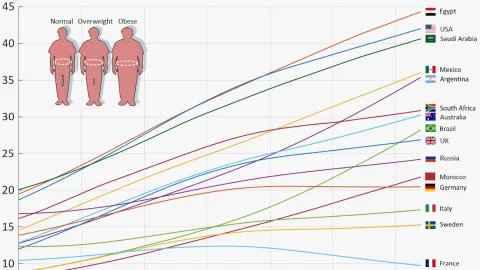
A quick glance at the graphic above shows that this truly is a global problem, impacting countries large and small. Thanks to Egypt, the USA is not the fattest country on the planet but we can take scant comfort in being #2.

A close look, however, reveals an interesting discrepancy. Of the 15 countries shown in the chart, only two do not show an ever increasing rate of obesity among their citizens. In Germany the obesity rate has leveled off, while in France is is actually decreasing.

How have these two countries managed to rein in the soaring rate of obesity? It turns out to be no mystery: by eating less and being more active on a daily basis. They didn't need $900 a month drugs or supplements or special diets or coaches or gym memberships to do it.

The French government introduced its National Nutrition Health Program in 2001, targeting schools, the food industry, restaurants and researchers, setting national standards, providing financial and educational support and tools and programs. It seems to be working.

In Germany, the flattening of the obesity rate seems due to changing eating habits, with younger generations consciously choosing a lighter, healthier diet over traditional German fare.

So with government intervention or without it, it seems to have come down to what we all knew all along. We eat too much of the wrong things and spend too much time sitting.

What are you going to do?

30 January 2025

Soy: Poison or Superfood?


Sometimes people can become so invested in a particular belief or position that no amount of new information can move the needle on their outlook. As Scrooge's nephew Fred said in A Christmas Carrol, "It seems the less uncle Scrooge knows, the more stubbornly he knows it."

This is not to suggest that there was never a good reason to regard soy and soy products with suspicion. Some of the earliest studies conducted on soy suggested that genistein, which is one of the primary isoflavones in soy, increased the risk of breast cancer, specifically estrogen receptor-positive tumors. These studies were preliminary, and done in mice. They used massive doses of pharmacological genistein (not soy itself) and contained so many methodological flaws that even some of the original study authors have retracted their conclusions.

In 2011, it was shown that mice and humans metabolize genistein very differently. Some types of mice are unable to metabolize isoflavones effectively, and were shown to have up to 150 times the amount of genistein concentrations in their blood than the highest concentration ever observed in human subjects. This study casts doubt on the usefulness of conducting soy-related studies on mice, and emphasizes the importance of using human studies to draw meaningful conclusions.

Subsequent human studies have been conducted, and have found women who consume more than two servings of soy per day have the lowest incidence of breast cancer. Among breast cancer survivors, higher isoflavone intake was associated with a lower risk of death. There may even be implications for soy in the treatment of breast cancer, as preliminary research suggests it may be able to destroy cancer cells. Much more research will be needed in that area, though.

Soy, and in particular genistein, seems to protect against a variety of other cancers, including prostate cancer. It seems to inhibit tumor growth with no effect on testosterone levels. Even uterine fibroids, benign but often causing pain and heavy menstrual bleeding, may be able to be treated with genistein. However, these studies were done in vitro, so further research is needed to determine if the findings are consistent in the human body.

Another concern about soy consumption is mostly from men. They have heard that the phytoestrogens in soy will have a so-called “feminizing effect” on them. There were a few individual case studies that suggested this could happen. The first example was of a man who was consuming three quarts (12 cups) of soy milk per day, and the second is of a man consuming multiple types of soy products daily, which amounted to around 360 mg/day of isoflavones — roughly nine times the intake of older Japanese men, who consume soy daily.

Well-designed studies and literature reviews have revealed soy intake at usual amounts to have no effect on physical appearance or male reproductive hormones, and support the long-held advice of health care practitioners: too much of anything, even healthy foods, can potentially have adverse effects.

Meanwhile, soy has been shown to have a large number of salutary heath benefits that include reduced cancer risk, reduction of serum cholesterol levels and overall heart health. For example, Lunasin, a peptide contained in soy protein, now has a well understood mechanism of action for producing these and other desirable outcomes.

The clear majority of the evidence points to soy not only being safe, but even beneficial for most people to consume. While people with certain medical conditions might want to talk with their doctors about including soy in their diets, most can do so with peace of mind. If you would like to read more about the latest scientific research on soy safety, here is a place to start. It includes suggestions for those who might still do well to avoid it.